Building an app no longer requires long timelines or expensive engineering teams. In 2026, AI-powered no code app builders let you describe an idea in plain English and generate production-ready web and mobile app in minutes.
I’m an AI engineer working with generative tools since 2018, and I’ve watched these platforms evolve from rough prototypes to capable app builders that handle UI, backend, and deployment.
Vibe coding is the newest pattern here: You describe the vibe or behavior you want, and the AI assembles the UI, data model, and workflows for you. Basically, Anyone can build their own web/mobile apps. Anyone can be programmers.
In this guide, You will get a hands-on review of the 7 leading AI no-code app builders in 2026, quick recommendations (top picks) for different needs, and practical tips to pick the right platform so you can build app ideas faster and with less risk.
What Are AI No-Code App Builders?
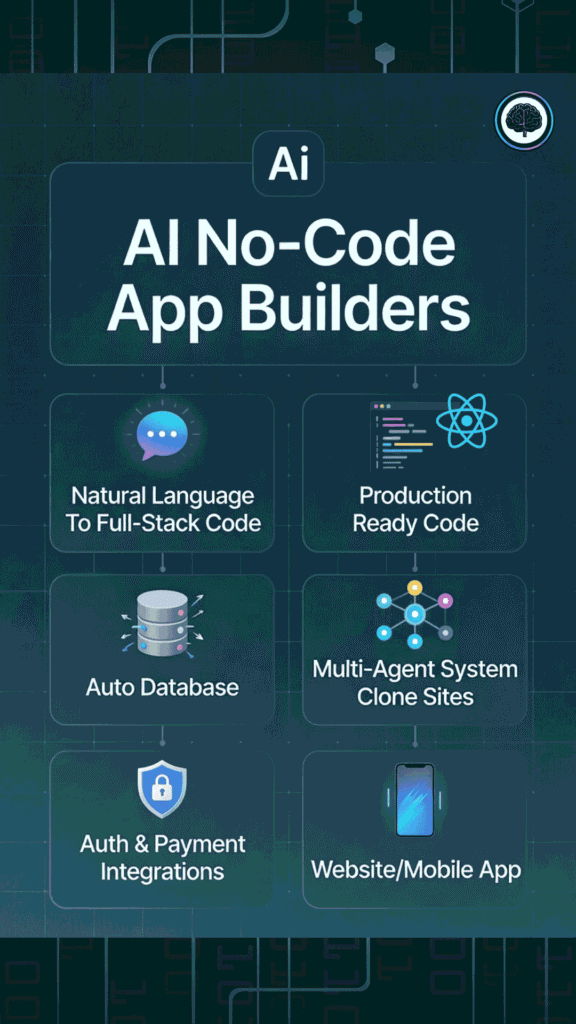
These are tools that let anyone build real apps — web ones, mobile ones, whatever, without writing even one line of code.
You just type what you want in normal English, like chatting with a super smart friend. The AI reads your words, figures out the design, the buttons, the data storage, the login stuff… and boom, it builds the whole thing for you. Often in minutes.
No need to learn programming languages, set up servers, or fix bugs yourself. The AI does the hard work behind the scenes.
For example:
Tools like Blink.new, Base44, or OnSpace AI do this right now. You chat, tweak with more messages (“Make the colors calmer”), and publish. It’s like having an instant developer team for free (or cheap).
The big win? The old barrier…”I don’t know how to code”…is basically gone. Anyone with an idea can turn it into something real and shareable fast.
What Is Vibe Coding?
Vibe coding is a modern way of building software by describing what you want in plain English instead of writing every line of code. Rather than manually coding in languages like Python or JavaScript, you explain the idea, behavior, and feel of an app, and AI generates the code for you.
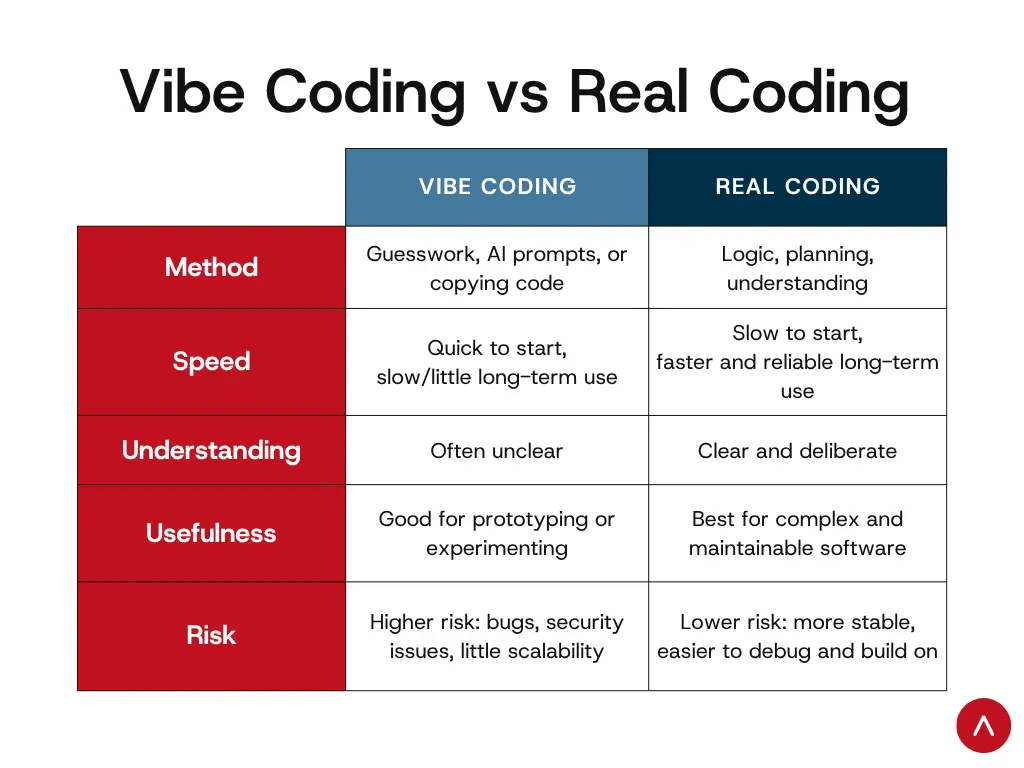
Technically, it’s a natural-language-first programming style where tools like Lovable.dev or similarAI code assistants translate intent into working software. Humans still guide and review the output, but the focus shifts from syntax to clear communication.
For example, you might ask the AI to:
In vibe coding, you act like the boss with the vision, and the AI is your super-fast builder who gets your style. No getting stuck on “how does this button technically work?” — You just say what feels right, iterate by chatting more (“Make it even simpler”), and end up with software that matches your gut.
In short, anyone with a clear idea and good instructions can start building apps — they don’t have to be traditional “coders” anymore.
How I Evaluated These AI No Code App Builders
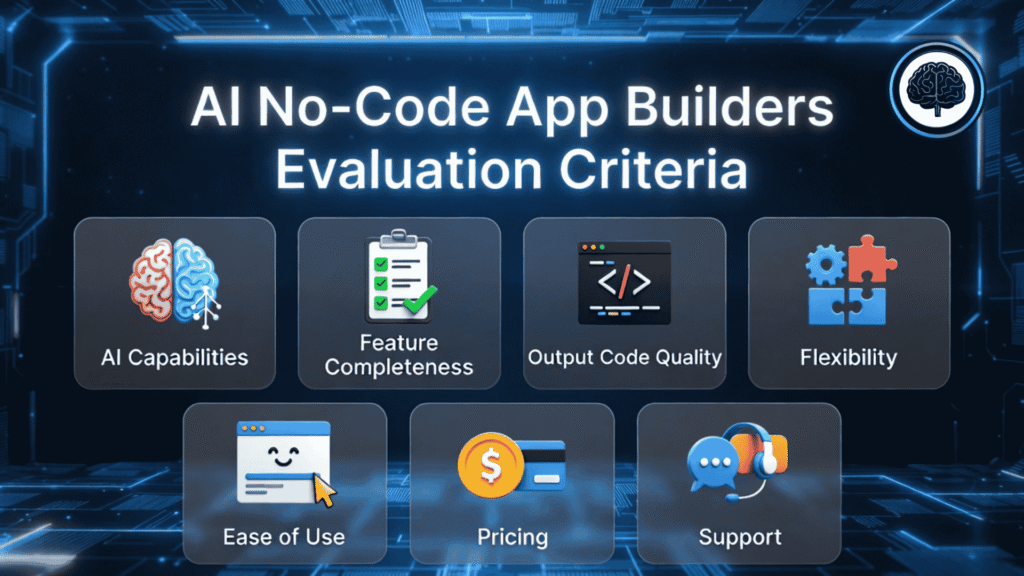
Before the reviews, transparency: I spent over 120 hours hands-on with these platforms — building and deploying real apps so my ratings reflect practical experience, not marketing copy. Test projects included a payment-enabled marketplace and an admin analytics dashboard so I could evaluate both frontend UX and backend correctness.
Use this quick checklist to understand the scoring and to help you get started when you try a new no-code app builder:
Why You Can Trust My Take on These AI No-Code App Builders
I’m not some random blogger skimming landing pages. I actually build stuff with these tools — and I judge them from two sides: The engineering side (is the code clean? does it scale?) and the product side (does it solve real founder problems fast?).
Quick background so you know I’m not guessing:
Every single review here comes from hands-on testing. I didn’t just sign up and poke around. I built real, deployable projects on each platform — dashboards, marketplaces, trackers, booking systems, you name it. Then I scored them using the same fair rubric (you can see the criteria I used earlier).
When I say a tool “blew me away” or “fell short,” that’s not hype or hate — it’s what actually happened when I tried to ship something useful. No fluff, no copied marketing lines.
You deserve opinions from someone who’s been in the trenches, not just reading about them. That’s me.
AI No Code App Builder Comparison Chart
| Rank | Tool | Best For | Best Features | Rating | Pricing |
|---|---|---|---|---|---|
| 1 | Blink.new | Production-ready apps (reliability) | Auto database/auth/storage/hosting, edge functions, AI model integration, self-fixing bugs, remixable community apps, 100% code ownership | 4.8/5 | Starter from $25/month |
| 2 | Base44 | Rapid prototypes & internal tools (natural language speed) | Natural language builder, discussion mode, auto database & auth, GitHub integration, real-time collaboration, built-in analytics | 4.7/5 | Paid plans from $20/month |
| 3 | Onspace AI | Mobile & web full-stack apps (cross-platform) | AI-driven generation for iOS/Android/web, mobile creator app, built-in PostgreSQL + Stripe, Figma import, GitHub code export | 4.6/5 | Pro from $25/month |
| 4 | Lovable.dev | Beginners & non-technical founders (exportable React) | Production-ready TypeScript/React code, Supabase integration, real code ownership/export, private projects, custom domains, Git version control | 4.6/5 | Pro from $25/month |
| 5 | Capacity.so | Startups needing precision (spec-first) | Natural language to full-stack code, agentic AI for bug fixing/refactoring, multi-file changes, Next.js/TypeScript/Tailwind output | 4.5/5 | Starter from $25/month |
| 6 | Grigora AI | SEO-optimized websites & content-heavy sites | AI website generator, drag-and-drop builder, AI content suite, integrated SEO tools, built-in hosting & CDN, newsletter marketing | 4.5/5 | Starter from $12/month |
| 7 | Emergent | Scalable web/mobile apps (multi-agent) | Multi-agent system for reliable builds, full-stack with integrations/auth/payments, code export | 4.4/5 | Tiered credit system (from ~$20/month) |
| 8 | Anything AI | Cross-platform apps (one codebase) | iOS/Android/web from one prompt, auto Postgres DB/Stripe payments, image gen, one-click deploy | 4.3/5 | Free tier available, paid from ~$19/month |
About the ratings: Scores are my subjective evaluations across AI capabilities, output quality, features (database, auth, payments), flexibility, and pricing. Check each full review for details and current pricing — these numbers can change quickly.
Top 3 AI No Code App Builders at a Glance

🥇
Blink.new
The reliability champion — ideal when you need production-ready apps with automatic bug fixes and robust backend generation.
Best for: Production SaaS, marketplaces, and high-availability apps
Platforms: Web apps with strong backend and CDN deployment

🥈
Base44
For fast prototyping — ideal when you need to turn ideas into working web apps in minutes using natural language.
Best for: Rapid prototypes, internal tools, MVPs, and quick web app development Platforms: Responsive web apps with automatic mobile-friendly design

🥉
OnSpace AI
For cross-platform Development— ideal when you need to build and monetize both native mobile (iOS/Android) and web apps from a single project.
Best for: Mobile-first MVPs, monetized apps, and full-stack applications
Platforms: Native iOS, Android, and responsive web applications
Best AI No Code App Builders Ranked
1. Blink.new – Best for Production-Ready Apps
Quick specs
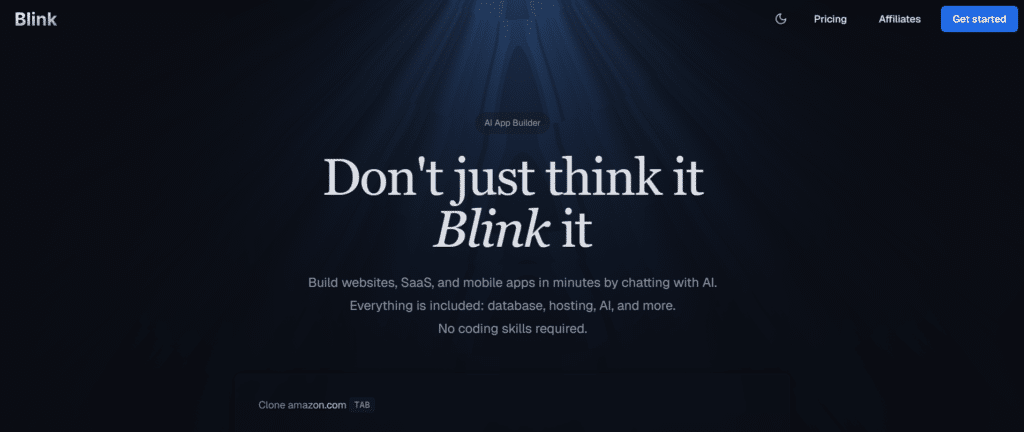
Blink.new has become one of the most reliable AI no-code app builders I’ve tested. Unlike many tools that produce pretty prototypes, Blink focuses on apps that actually run in production — with sensible backend design, error handling, and deployment built into the workflow.
4.8
OVERALL RATING
Key Pain Points Blink.new Solves
Highlighted Features
Real-World Success Story
“Wow, Kai, this product is unbelievable! I built a full-featured GPT 4.0 clone, wrote a legal brief, and even analyzed an X-ray image – all in less than 25 minutes. This would have taken a team weeks.”
— Haroon H MD, MBA, JD Candidate
The Blink.new Experience
Start by describing your app; Blink asks clarifying questions when requirements are ambiguous (similar to a senior engineer). The platform generates frontend and backend together, and you get an interactive preview immediately.
The debugging experience stands out — Blink frequently identifies issues and either fixes them or gives a clear remediation suggestion (e.g., “Fixed: form submission error when email field is empty”).
Pros and Cons


Deployment checklist — how I got a marketplace production-ready
Integrations & Support
Blink.new includes native connectors for Stripe, Firebase, and AWS S3, and supports common auth providers. It is API-first, so connecting external services is straightforward.
Community docs and forums are the primary support channels; paid plans include priority email support (response times reported around ~6 hours, though SLA varies by plan).
Pricing
Reliable & Fast Path To Your App Deployment!
Choose Blink.new if you need a reliable backend, strong error handling, and fast path to production. It’s especially good for marketplaces and SaaS where uptime and data integrity matter.
2. Base44 – Best for Rapid AI-Powered Prototyping
Quick specs
- Best for: Non-technical users who want to turn ideas into working web apps and internal tools extremely fast
- Platforms: Responsive web apps with automatic mobile-friendly design
- Code export: GitHub integration and code assistance available
- Pricing: Free tier with daily/monthly limits; paid plans start from $20/month
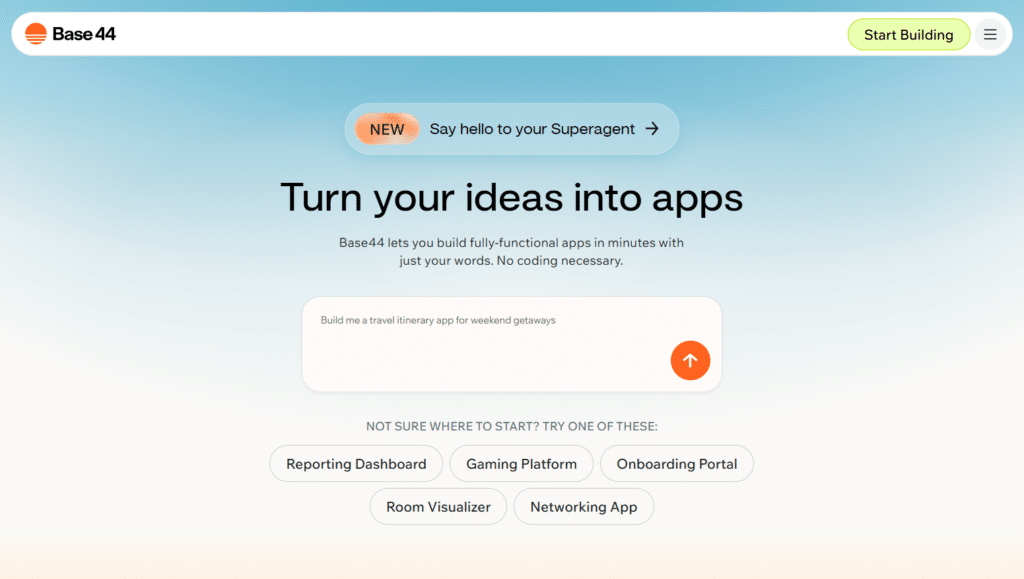
Base44 is an AI-powered no-code platform that lets anyone build fully functional web applications using only natural language. It focuses on speed and simplicity.
Just describe what you need, and the AI handles the rest, from UI to backend logic and infrastructure.
4.7
OVERALL RATING
Key Pain Points Base44 Solves
Highlighted Features
Real-World Success Story
“Base44’s AI infrastructure capabilities and API-first approach made it the perfect fit for Lunair’s video generation platform. Unlike traditional no-code builders, Base44 excels at handling complex backend operations and integrations – exactly what we needed for our video rendering pipeline and multiple third-party connections (Lemon Squeezy, Stripe, etc.).
The platform gave us the flexibility to build fully-functional features without slowing down development, while still maintaining the technical depth required for AI-powered video processing.“
— Guy Manzur, Used Base44 to build Lunair
The Base44 Experience
You start in a clean chat interface where you describe your idea. The AI generates the app structure, pages, and backend. You can then use visual edits, discussion mode for planning, or continue chatting to add features. Everything stays conversational and fast, with changes appearing in real time.
Sample prompt that produced a dashboard app:
“Build a project management dashboard with task lists, team assignments, progress tracking, and email notifications.”
Base44 created the UI, database, auth, and workflows in one pass. We were able to apply our own edits and modifications as needed
Pros and Cons
Quick Note: What to Keep in Mind When Rapid Prototyping with Base44
When using Base44 for rapid prototyping, keep these important points in mind:
Rapid prototyping with Base44 works best when you stay focused, iterate quickly, and treat the AI as a collaborative partner rather than expecting perfection on the first try.
Integrations & Support
Base44 includes built-in support for emails, SMS, Stripe payments, and external APIs. It also connects with tools like Google Drive, Salesforce, and Zapier. GitHub integration allows code-level work. Support is provided through in-app assistance, documentation, and community resources. Enterprise plans offer dedicated help.
Pricing
AI No-Code App Builder With Rapid Prototyping!
Use Base44 to transform your ideas into fully functional web apps in minutes using nothing but words. Perfect for rapid prototyping, internal tools, and MVPs without hiring developers.
3. Onspace AI – Best for Mobile & Web Full-Stack App Building
Quick specs
- Best for: Founders and creators who want to build and monetize both mobile (iOS/Android) and web apps quickly
- Platforms: Native iOS, Android, and responsive web applications
- Code export: Full code download with GitHub integration supported
- Pricing (as tested): Free to start; Pro plan at $25/month (verify current pricing)
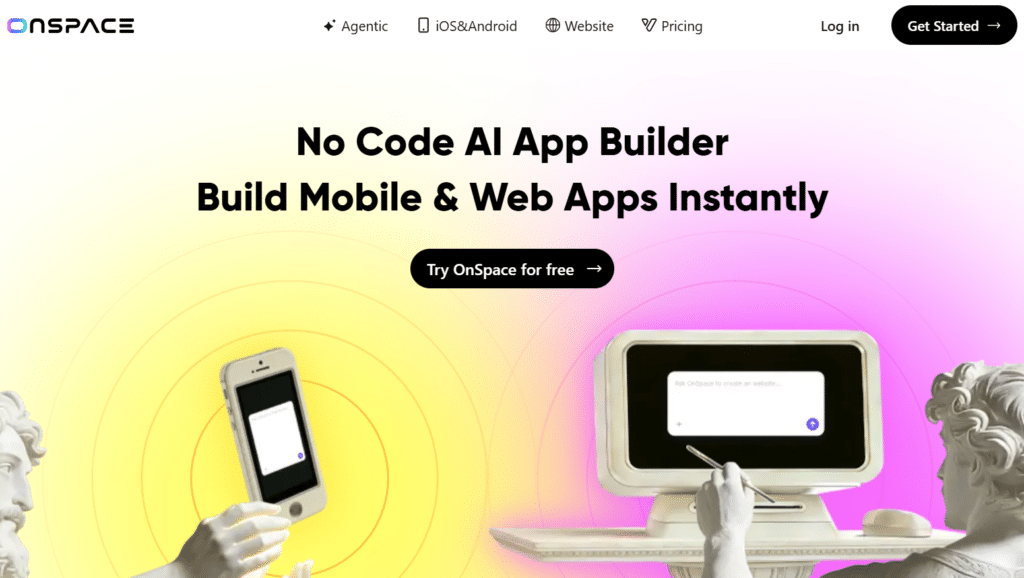
Onspace AI is a powerful no-code AI builder that lets you create full-stack mobile apps (iOS & Android), web applications, and landing pages using natural language prompts. It combines AI generation with a mobile-first creator app so you can build, edit, and deploy real apps from anywhere.
4.6
OVERALL RATING
Key Pain Points OnSpace AI Solves
Highlighted Features
Real-World Success Story
“No developer needed. Saved $15K on my MVP.“
—Alex T., Tech Entrepreneur
OnSpace AI’s impact mirrors what many early-stage founders need most: speed, simplicity, and serious cost savings. Built for rapid MVP creation without technical overhead, it empowers non-developers to launch functional products fast.
In one real-world case, a tech entrepreneur reported saving over $15,000 in development costs by skipping the traditional dev route entirely. Instead of hiring engineers or waiting weeks for builds, OnSpace AI enabled a fully working MVP—proving that lean execution doesn’t have to mean compromised quality.
The OnSpace AI Experience
Onspace AI offers a clean visual builder combined with a smart AI assistant. You can start by describing your idea in plain text, import from Figma, or use drag-and-drop.
The dedicated mobile app lets you continue building on the go, with everything staying perfectly synchronized across platforms.
Sample prompt that produced a booking app:
“Build a service booking app with user accounts, calendar, Stripe payments, and admin dashboard for web and mobile.” — Onspace AI generated the complete UI, database, payments, and native apps in one go.
Pros and Cons
When to pick Onspace AI — quick decision rule
Integrations & Support
Onspace AI includes native support for Stripe payments and PostgreSQL. It also supports Figma imports and GitHub for code export. Additional API integrations are available through the platform. Support is provided via in-app AI assistant, documentation, and priority customer service on higher plans.
Pricing
Full-Stack AI No-Code App Builder!
Use Onspace AI to create native mobile (iOS & Android) and web apps using natural language — with built-in database, payments, and code export. Build from your phone and launch faster than ever.
4. Lovable.dev – Best for Beginners and Non-Technical Founders
Quick specs
- Best for: Web apps, dashboards, and teams that want exportable React/TypeScript code
- Platforms: Web (React + TypeScript) — not native mobile
- Code export: Yes — full codebase download / GitHub sync
- Pricing (as tested): Free tier; Pro from ~$25/month; Enterprise custom
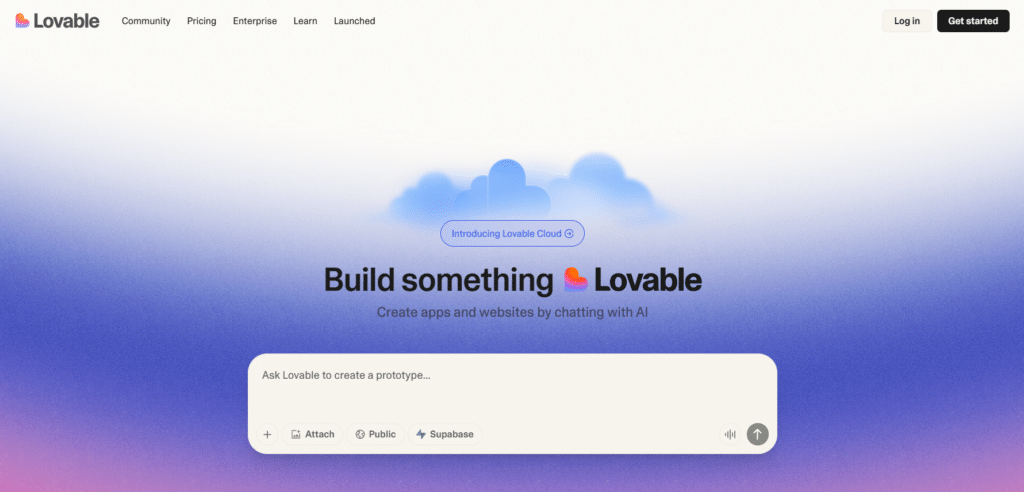
I was skeptical when I first tried Lovable.dev’s claim of “beautiful React apps from English prompts.” After building three client projects and several prototypes, it’s clear Lovable is one of the strongest AI no-code app builders for non-technical founders who need production-quality web apps and the option to own the code.
4.6
OVERALL RATING
Key Pain Points Lovable.dev Solves
Highlighted Features
Real-World Success Story
“We launched our fintech dashboard in 3 weeks instead of 3 months using Lovable. The AI understood our complex requirements for visualizing transaction data and user permissions. Investors were impressed we built it without hiring a dev team at first.“
— Sarah C, Founder of FinTrack
FinTrack’s case is typical: Lovable shines on data-heavy web apps (dashboards, admin panels) where UI polish and clean code matter. The team estimated an initial development cost savings north of $50k by using Lovable for the MVP.
The Lovable.dev Experience
Work begins by describing your product (or starting from a template). The AI generates an initial project — UI, routes, and basic backend wiring…which you iterate on with follow-up prompts.
Example: “Add a filterable table for transactions showing date, amount, status, and a CSV export” produced a working table with sorting, filtering, and export in my test without manual wiring.
On mobile layouts Lovable.dev added responsive patterns automatically (collapsible nav, touch targets). One caveat: since the primary output is React web, native mobile apps require additional tooling or wrappers if you need app store builds.
Pros and Cons
Deployment notes & common pitfalls
Lovable makes it easy to prototype and export code, but teams occasionally hit a “technical cliff” when configuring custom infrastructure (CI/CD, advanced server-side functions, or proprietary DBs). Mitigations:
Integrations & Support
Lovable.dev integrates natively with Supabase for backend tasks and supports Stripe and SendGrid for payments and emails. It can connect to Auth0 for advanced authentication flows and syncs code to GitHub for a development-friendly workflow.
My experience with support was positive — rapid responses and helpful onboarding…though response SLAs can vary; Treat any specific “under 3 hours” claim as situational and check current support terms.
Pricing
If you need exportable React code, start here!
Lovable.dev is my top pick for teams that want beautiful web apps and the ability to take the code off-platform.
5. Capacity.so – Best for Startups Needing Precision
Quick specs
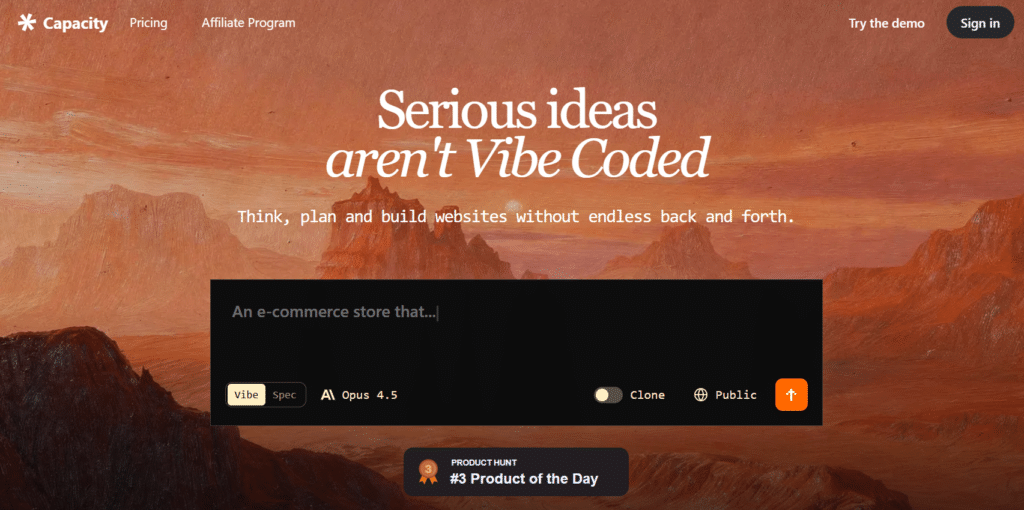
Capacity.so takes a specification-first approach to AI app building. Instead of casual prompts, you complete structured briefs (user stories, data models, workflows) so the AI produces precise, reliable implementations that match your requirements.
4.5
OVERALL RATING
Key Pain Points Capacity Solves
Highlighted Features
Real-World Success Story
“ “A product with a supportive team & high innovation!”
The Capacity team is continually working to understand the needs of their customers, optimize the product, and innovate new solutions! The team we work with is so helpful in providing recommendations and actively taking in our questions or feedback. As we continue to utilize Capacity for our teams, I’m confident we’ll continue to see more and more value in the product!”
— Mary Kate W., Small Business Owner (G2)
Ideal use cases
Quick-start tips for new users
Pros and Cons
Prompt templates — how to write a good structured brief
Use these as a starting point when you create a brief with Capacity:
These templates help Capacity generate accurate data models and UI flows on the first pass.
Integrations & Support
Capacity integrates with deployment and developer platforms (GitHub, GitLab, Vercel, Netlify) and common databases (MongoDB, PostgreSQL, MySQL).
Paid plans include Slack support channels; response times vary by tier — reported under an hour for paid customers during business hours, but confirm current SLAs directly.
Pricing
Start Generating Apps with Precise Details!
Capacity is ideal when you need accurate, maintainable apps that follow detailed specs. Use the structured brief templates above to speed your first successful generation.
6. Grigora AI – Best for AI-Powered Website & Content Creation
Quick specs
- Best for: Bloggers, small businesses, agencies, and content creators who want fast, SEO-optimized websites with built-in marketing tools
- Platforms: Responsive web websites with strong mobile optimization and blogging focus
- Code export: Limited custom code support; platform-first with drag-and-drop and embeds
- Pricing: Starts from $12/month (Starter); no free tier mentioned (verify current pricing)
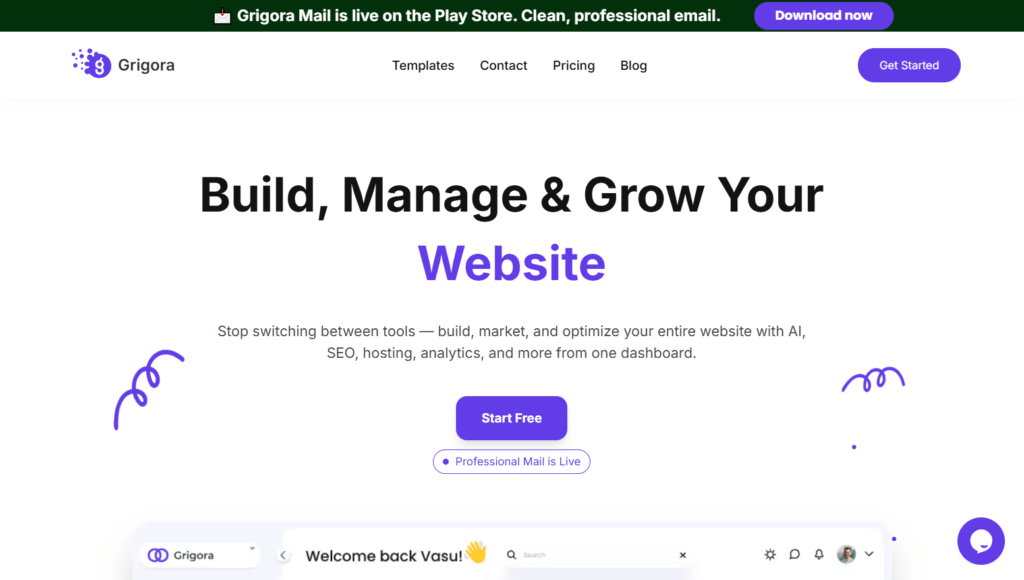
Grigora is an all-in-one AI website builder that combines drag-and-drop design, powerful AI content tools, integrated SEO, hosting, and marketing features in a single dashboard. It serves as a modern WordPress alternative, allowing users to create, optimize, and grow professional websites without juggling multiple tools.
4.5
OVERALL RATING
Key Pain Points Grigora Solves
Highlighted Features
Real-World Success Story
“Blazing Fast and SEO-Focused Platform
I love Grigora’s blazing fast performance and simple, intuitive interface. It’s a dream for SEO-focused developers. Its speed and flexibility have boosted my workflow and improved my content deployment. The lightweight design, SEO focus, plugin compatibility, and user-friendly UI are standout features. Additionally, the seamless integration with various tools makes managing projects much easier.
I appreciate how regularly the platform receives updates, ensuring it stays current with SEO best practices. Overall, Grigora has significantly enhanced both my productivity and the quality of my work.“
— Dr Kaushik Saha P., Grigora User, G2
The Grigora Experience
Start with a template or AI-generated site, then refine everything using the intuitive visual editor. The AI copilot assists throughout — suggesting content, optimizing SEO, and generating images or links as you build. Everything from design to analytics lives in one clean dashboard for seamless workflow.
Sample prompt that produced a business site:
“Create a modern fitness coaching website with blog, booking form, SEO optimization, and newsletter signup.”
Grigora AI generated the full layout, content, images, and SEO setup instantly.
Pros and Cons
Cost comparison — example first-year spend
Grigora can be significantly cheaper and simpler than managing multiple tools, especially for bloggers and small businesses who want fast AI-powered content and SEO.
Integrations & Support
Grigora integrates with Google Analytics, Google Search Console, Zapier (via webhooks), Stripe/PayPal embeds, and basic form tools. Support includes email (all plans), priority support (Pro+), phone support, and onboarding assistance (Business plan). Documentation and community resources are available.
Pricing
All-in-One AI Website Builder!
Use Grigora AI to create professional, SEO-optimized websites with AI-generated content, built-in marketing tools, and reliable hosting — all in one powerful platform. Perfect for bloggers, businesses, and agencies who want speed and simplicity.
7. Emergent – Best for Scalable Web/Mobile Apps
Quick specs
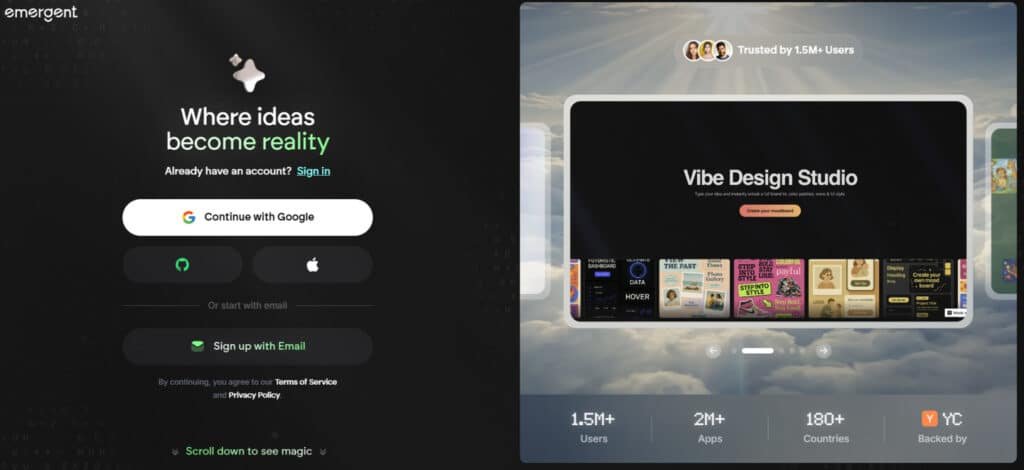
Emergent distinguishes itself with a multi-agent architecture: Specialized AI agents collaborate on UI, database design, business logic, and deployment. This reduces the “single brain” limitations of monolithic prompt systems and improves reliability for large, multi-component projects.
4.4
OVERALL RATING
Key Pain Points Emergent Solves
Highlighted Features
Real-World Success Story
“ Emergent is a VERY robust vibe coding platform. I built a rather complex business assessment tool that required a database for storing all the information, generating PDF reports, and providing backend login and admin functions. With all vibe coding apps, you need to iterate as functionality is added, but Emergent understood what I needed and produced great outputs.
I especially appreciated the automated testing before publishing functions. Publish was clean, and my app is live. I didn’t realize there was a monthly cost to keep the app live initially, but the fee is relatively small given the app’s value. I highly recommend Emergent.“
— Steve Grady, Product Hunt
The Emergent Experience
Start by describing your app at a high level; Emergent breaks requirements into agent tasks and shows progress as each agent completes its work.
You can target feedback to specific agents (e.g., “UI agent: reduce sidebar width” or “DB agent: add index on user.email”) and watch changes propagate through the system. This fine-grained control reduces regressions when iterating on complex features.
Pros and Cons
Enterprise checklist — what to ask before you buy
Integrations & Support
Emergent offers connectors for Auth0/Firebase (auth), Stripe/PayPal (payments), AWS S3/Google Cloud Storage (file storage), and analytics tools.
Community forums and docs are available; enterprise customers get priority support and dedicated onboarding. Verify current integration lists and support SLAs directly with Emergent.
Pricing
Build Production-Ready Apps Through Conversation!
Choose Emergent when you need a scalable, auditable codebase and domain-specialized AI agents for production applications.
8. Anything AI App Builder – Best for Cross-Platform Apps
Quick specs
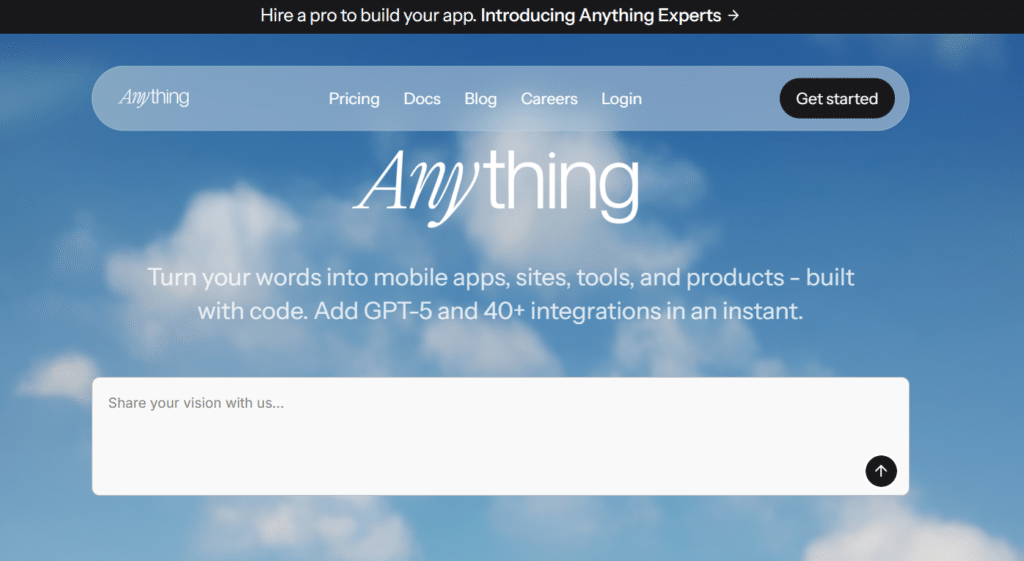
Anything AI App Builder is focused on eliminating platform fragmentation: build once, deploy across web and mobile with platform-specific optimizations.
In my testing it handled a non-trivial habit-tracking app and produced device-appropriate UI, working storage, and push/notification hooks with far less manual work than maintaining separate codebases.
4.3
OVERALL RATING
Key Pain Points Anything AI Solves
Highlighted Features
Real-World Success Story
“ We rebuilt our job marketplace with Anything AI and consolidated three codebases into one. The unified platform let us ship AI-powered job matching and increased development velocity by 300%.“
— Marcus Johnson, CTO of JobConnect
JobConnect’s consolidation example shows the productivity gains from a single codebase approach, particularly when adding advanced features like AI matching where consistency across platforms matters.
The Anything AI Experience
Begin by describing your app or selecting a template. Anything AI shows live previews across devices and lets you tweak platform-specific behaviors.
Iteration feels similar to other vibe-coding platforms: Provide a prompt (e.g., “add premium subscription with Stripe payments and server-side validation”) and the platform wires payments, webhooks, and UI flows.
Pros and Cons
App store workflow — what’s automated vs what you must do
Anything AI automates build generation and packaging for app stores, but you still need developer accounts (Apple/Google), store metadata, and any compliance steps (privacy policy, screenshots). Typical workflow:
Compare: Anything AI vs Emergent & Lovable
Integrations & Support
Anything AI integrates with Stripe, Firebase, AWS, Common auth providers and 40+ Integrations. Support is through docs and a community forum, with email and priority options for paid tiers. For app-store builds, consult Anything AI’s mobile-build docs and the platform’s checklist to ensure a smooth release.
Pricing
Build Production-Ready Apps Through Conversation!
Choose Emergent when you need a scalable, auditable codebase and domain-specialized AI agents for production applications.
Key Features to Look for in AI No Code App Builders
After testing these platforms and building real no-code apps, the difference between a hype tool and a useful no-code app builder comes down to a few practical features. Below is an actionable checklist you can use when evaluating platforms, plus quick tests to verify each capability.
| Feature | Why it matters | Quick test to verify |
| Natural language understanding | Good NL understanding reduces iteration and lets non-technical users describe complex screens and workflows. | Give a multi-step prompt (e.g., “Create a dashboard with filters, date range, and CSV export”) and confirm the generated UI + wiring works. |
| Customizable design system | Avoids templated, generic-looking apps and helps deliver branded, professional interfaces. | Ask for a brand color scheme and logo; check whether the platform applies styles site-wide and allows component tweaks (not just drag drop boxes). |
| Comprehensive components & integrations | Pre-built components (tables, charts, forms) and integrations (payments, email, storage) speed development of real-world features. | Test adding a payment flow (Stripe) and a file upload; verify server-side validation and webhook handling. |
| Database & backend robustness | Production apps need reliable DB schemas, relationships, indexing, and backend logic — not just static UI. | Inspect the generated database schema or ask the platform to show the DB model; run queries and test edge cases (empty sets, concurrency). |
| Code export / ownership | Protects you from vendor lock-in and allows developers to extend or migrate your app later. | Attempt an export or GitHub sync (Lovable, Emergent show this). If code download isn’t offered, treat it as a managed-service tradeoff. |
| Rapid iteration & multi-file changes | Fast edits and consistent multi-file updates cut iteration time and reduce regressions. | Ask the platform to “Update X across the app” and verify changes propagate across pages/components within seconds. |
| Error handling & edge-case management | Apps that only work on happy paths break in production; built-in error handling is essential for reliability. | Simulate failure scenarios (payment decline, upload network failure) and confirm the app responds gracefully. |
| Zero-configuration options | For quick prototypes or non-technical users, built-in auth, DB, and hosting remove blockers. | Set up an app from prompt and confirm auth, DB persistence, and hosting are provisioned with no manual infra steps (Mocha, HeyBoss examples). |
| Drag-and-drop & component control | Useful for visual tweaks and rapid layout adjustments, but should not replace prompt-driven precision. | Try modifying a screen via drag drop and compare results vs a prompt-based change; both should be available. |
Best Practices for Using AI No Code App Builders

After building dozens of projects with these platforms, I’ve distilled practical practices that help you get the most from any AI no-code app builder. Apply these to reduce iteration time, avoid surprises, and ship reliable apps.
Practical prompt templates
QA checklist before going to production
Mitigating vendor lock-in
If code export is important, pick a platform that allows it (e.g., Lovable, Emergent). Alternatively, keep your database in a portable service (Postgres/Supabase) and regularly export backups. Document your deployment and build steps so you can replicate the app outside the platform if needed.
These practices will help you get started faster, reduce surprises, and build apps that scale beyond prototypes. Start small, iterate quickly, and use the community and prompt library to accelerate development.
Red flags to watch for
Key Takeaways
Which to try first — quick decision shortcut
Next steps
Conclusion
The landscape of AI no-code app builders has matured rapidly by 2026. These platforms make it possible to design, generate, and ship web and mobile-friendly apps far faster than traditional development—especially for dashboards, marketplaces, internal tools, and standard business workflows.
Based on extensive hands-on testing, Lovable.dev is my top pick for most teams because it combines ease of use with professional-quality output and clean, exportable code. That said, the best platform depends on your project: Blink.new for production-grade reliability, Mocha for rapid prototypes, Capacity.so when you need specification-level precision, HeyBoss for small-business systems, Emergent for enterprise-scale apps, and Anything AI for single codebase cross-platform projects.
How to get started (micro-checklist)
- Pick 1–2 candidate platforms from this guide based on your use case.
- Choose a small test project (auth + one core feature) and run a 1-day prototype.
- Evaluate portability: can you export code or use your own database?
- Follow the Best Practices (clear spec, incremental builds, edge-case testing).
Ready to build your app?
Try one of these starters depending on your priority
Start small, iterate quickly, and keep portability in mind so your app can grow beyond any single platform