You know your site ranks for dozens of queries, but most wins are scattered and slow to scale. That cost in wasted traffic and missed leads can sting — especially when competitors move faster.
I felt that frustration myself. Pulling Search Console data, guessing which pages to tweak, and waiting on developers drained time and momentum. You need a faster way to turn small ranking pockets into steady gains.
Enter seo scout — a platform that merges Google data with its own crawler, surfaces clear insights, and runs JS A/B tests so you can lift CTR and ranks without full dev cycles. It’s built for businesses of all sizes (from freelancers to enterprise) and starts at $49/month with a free trial.
In this hands-on SEO Scout review I’ll show how I synchronize keywords, prioritize quick wins, and scale those gains across pages. If you want practical, repeatable flows that boost traffic and ease workload, let’s dive in.
Key Takeaways: SEO Scout Review
- I explain how the platform links Search Console with crawling to find quick optimization wins.
- Core features include content optimization, rank tracking, A/B testing, and competitor analysis.
- Works for solo consultants up to enterprise teams — pricing starts at $49/month with a trial.
- Focus is on fast, developer-light tests that lift CTR and long-tail rankings.
- You’ll get step-by-step testing flows I used, plus honest pros and cons to decide fast.
SEO Scout Review: An Overview
Raamish’s Take
SEO Scout provides a smart SEO analysis platform that digs into your site’s data for real gains.
It pulls data from Search Console and its own crawler to spot low CTR titles or thin content, then lets you test fixes like new metas without dev help.
The internal linking tool catches weak spots, suggesting relevant pages to boost topical authority. For content, the NLP topic research scans top results for missing entities, so you can add depth and rank higher. Agencies use it to track unlimited keywords across sites, uncovering long-tail wins.
Ever tweak a page and wonder if it worked? Its split testing shows clicks and position shifts fast. Compared to Ahrefs ($99/mo with broader scope but steeper learning), SEO Scout focuses on actionable audits at half the price for SMBs.
With features like keyword cannibalization detection, it prevents self-sabotage. Solid for steady traffic lifts.
Introduction to SEO Scout
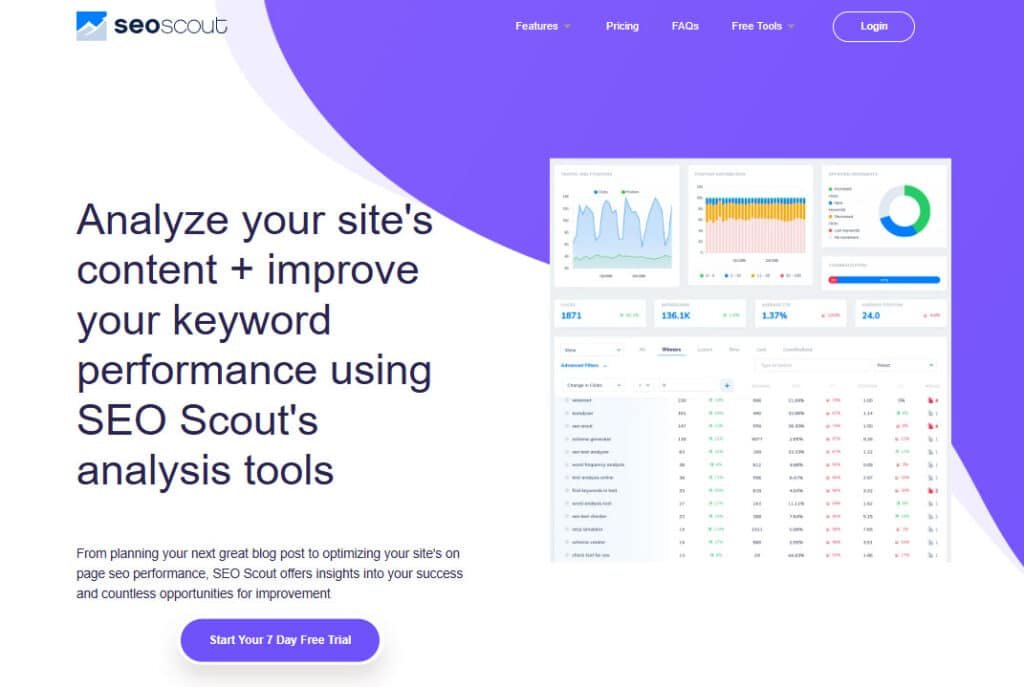
You don’t need another flashy dashboard—what helps is a platform that turns search console data into action, and that’s where seo scout sits.
Where it fits in today’s AI-driven landscape
In an AI-heavy era, I find this platform pragmatic: it uses artificial intelligence for prioritization and pattern-finding, not for opaque recommendations. The result is clearer signals you can act on fast to grow organic traffic.
Who built it and what it aims to solve
Built and run in the United States, the team blends crawling tech with Google Search Console to surface on-page and content opportunities. Its stated purpose is simple—help businesses bridge the gap between the content you have and the content that performs.
Who uses it: freelancers to enterprise
The audience ranges from freelancers and startups to mid-size and enterprise organizations, plus nonprofits and government sites. Online support and documentation make self-serve onboarding practical for varied strategies.
- Core features: keyword research, rank tracking, content optimization, competitor analysis, A/B testing, link management, and AI-driven insights.
- Expectations: I provide a hands-on analysis of where the platform speeds prioritization and where you might need complementary tools.
“A tool that links owned data with crawling and tests—that’s the practical difference for teams wanting measurable lifts.”
What Is SEO Scout?
You want a system that turns raw console numbers into clear, page-level actions. I’ve used the platform to map Search Console signals to specific edits—so you stop guessing and start improving results.
How it works: search console data + a proprietary crawler
At a nuts-and-bolts level, the platform ingests your search console data and overlays a crawler that reads page content and structure. That pairing highlights mismatches between what a page says and how it actually performs in the search results.
The testing suite uses a JS method to run A/B experiments on titles and meta without a full dev sprint. That means you can validate changes for CTR and long-tail visibility before committing to large rewrites.
Core benefits for ideal users
- Faster keyword wins: prioritized opportunities per page so you can tighten headings, expand sections, or adjust H1s.
- Measurable experiments: title/meta A/B tests that prove uplift in CTR and seo performance.
- Actionable insights: on-page suggestions, rank and mobile tracking, and content cues that help businesses scale organic search tactics.
“Fewer meetings, more controlled experiments, and a steady climb in performance where it matters.”
Best Features of SEO Scout
I’ll summarize the main features, the price, and the practical trade-offs so you can decide fast.
1. SEO Analysis
SEO Scout’s SEO analysis blends your Google Search Console data with its own crawler to check your website content against rankings.
This approach spots quick wins for organic traffic. For users managing a website, it highlights things like untapped keywords and weak spots, helping boost visitors without guesswork.
By focusing on priority fixes, this feature in the seo tools suite lets you improve SERP positions fast, turning data into actionable steps for better search results.
2. AI-Powered Stuff
The AI side of SEO Scout uses NLP for topic research on top results for your keywords. It pulls entities and terms from competitors, then grades your content to add missing pieces.
This makes your posts more comprehensive for Google. Readers searching for advanced seo tools get help creating high-quality content that ranks higher, as the tool suggests FAQs from People Also Ask and more.
It integrates with your account to reveal things competitors cover, aiding in deeper, ranking-boosting updates.
3. Testing Tools
SEO Scout’s testing lets you tweak titles, metas, or content via JS without devs. Use templates for bulk changes on thousands of pages, then track impacts on positions and clicks.
This seo tools option analyzes core metrics and drills into moved keywords. For site owners, it helps test changes safely, improving CTR and long-tail traffic before going live.
The approach provides detailed reports on what works, ensuring every update drives real gains in your website performance.
4. Tracking and Monitoring
As a top rank tracking tool, SEO Scout offers unlimited rank tracker from all Search Console keywords, ignoring daily fluctuations.
It auto-monitors site changes and delivers reports on positive or negative effects. Users benefit by seeing long-tail drivers and low-CTR fixes, linking your account for full visibility.
This tracking tool helps track every keyword your website appears for, providing client-ready reports to prove value and guide optimizations.
5. Audits and Fixes
SEO Scout runs content and technical audits to flag issues like thin pages or slow loads on your website. It prioritizes fixes that lift rankings overnight, from links to tags.
Among seo tools, this uncovers weak points holding back performance. Readers get targeted reports to resolve things quickly, enhancing site health and SERP spots without overwhelming lists.
6. Internal Links
This feature analyzes your website‘s internal links, spotting low-link pages and anchor diversity. The opportunity tool suggests relevant links with optimal text for topical boosts.
It helps build relevance, signaling keywords to Google. For SEO pros, it diversifies anchors and connects content, improving authority and traffic through strategic linking.
7. Content Optimization
SEO Scout digs into Search data for untapped queries and FAQs your website ranks for but doesn’t target. It compares pages to keywords for missing synonyms in titles and copy.
This seo tools feature highlights high-impression ones, letting you create targeted pages for instant ranking claims. Users optimize content easily, claiming page-one spots with simple tweaks.
8. Keyword Tools
The keywords finder generates thousands of ideas, filtered by volume and CPC for briefs. It spies competitors’ top keywords and pages, plus groups for clusters.
As a rank tracker companion, it uncovers long-tail opportunities. This aids content planning, helping readers build strategies around profitable terms and expand keyword coverage effectively.
9. Cannibalization Fix
SEO Scout tracks URLs and keywords to spot cannibalization where multiple pages compete. It suggests consolidations or link tweaks to guide Google.
Among seo tools, this prevents self-competition, clarifying top pages. Users resolve issues fast, boosting clarity and rankings for specific queries.
10. Performance Reporting
This tracker analyzes rank tracker data for near-miss keywords and trends over time. It compares keyword visibility and offers competitor insights for ideas.
The report feature tracks growth, helping users spot low-CTR things and adjust. It provides a full view of performance, enabling data-driven decisions to sustain and grow organic results.
AI Dashboards & Analytics Synergy
Dashboards surface prioritized actions with confidence scores. Combining Google Analytics and search console data helps diagnose why impressions rise but clicks don’t.
| Feature | Benefit | Best for | Notes |
|---|---|---|---|
| Keyword research tools | Find volume, difficulty, gaps | Content teams | Maps gaps vs competitors |
| Rank & mobile tracking | Daily position and device split | Local & national sites | Detects mobile cannibalization |
| JS testing suite | A/B titles/meta with no dev | Marketing teams | Fast validation of CTR changes |
| Backlink management | Monitor profile health | Link builders | Tracks new/lost links |
“Prioritize high-impression, low-CTR pages—test titles first, then expand content.”
Pricing Plans of SEO Scout
Starter Plan
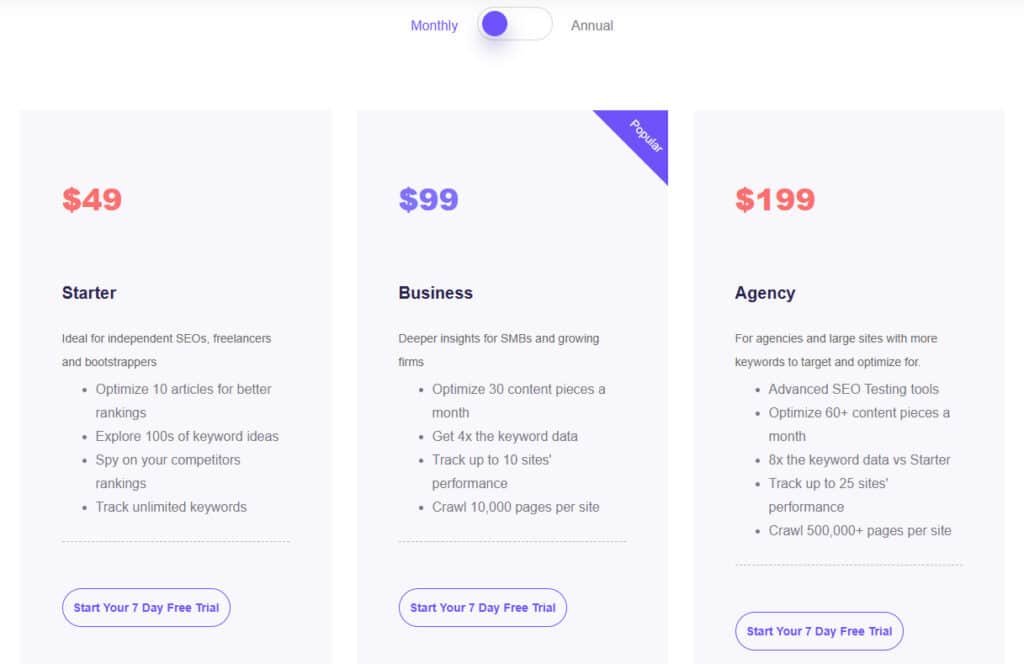
The Starter plan costs $49 monthly or $490 annually, ideal for freelancers and independents. Features include optimizing 10 articles, exploring hundreds of keyword ideas, spying on competitor rankings, and tracking unlimited keywords with reports on performance and group.
Business Plan
Business plan is $99 monthly or $990 annually, suited for SMBs seeking deeper insights. It offers optimizing 30 content pieces, 4x keyword data, tracking up to 10 sites via one account, crawling 10,000 pages, and detailed reports.
Agency Plan
Agency plan runs $199 monthly or $1992 annually, for agencies with advanced needs. Features advanced SEO testing, optimizing 60+ pieces, 8x keyword data versus Starter, tracking 25 sites, crawling 500,000+ pages, and comprehensive reports on group.
Pros & Cons of SEO Scout
Pricing starts at $49/month and includes a free trial. Documentation and online support help onboarding.
- Pros: Actionable insights, broad feature set, supports SMB to enterprise, and practical testing that moves the needle.
- Cons: Limited listed integrations and a learning curve to adopt the full suite.
Alternatives
Tools like NEURONWriter shine for on-page tweaks, using AI to score content against top SERPs and suggest keywords or headings.
It’s great if you want quick optimizations, but pricier at $59/month basic, lacking Scout’s full audits and internal linking.
Frase focuses on content briefs and SERP summaries, pulling FAQs to build outlines fast. Handy for writers, yet it misses Scout’s rank tracking or cannibalization fixes—starts around $14/month but scales up.
Outranking uses NLP for topic depth, grading your copy on entities. Simple for enterprises, but fewer integrations than Scout; expect $170/month.
For all-in-one power, Keywordly crushes with AI Content optimization for insights, Keyword Discovery and Keyword Clustering for $19+/month.
Pick based on needs—Scout wins on affordability for testing and tracking.
| Tool | Starting Price (Monthly) | Key Strengths | Best For |
| SEO Scout | $49 | Rank tracking, audits, internal links, split testing | Content creators needing all-in-one basics |
| Outranking | $19 | Content scoring, NLP optimization, AI writing | Content creators focused on on-page tweaks |
| Frase | $45 | AI briefs, unlimited words, SERP analysis | Writers building outlines fast |
| NEURONWriter | $19 | Semantic grading, keyword discovery | Teams wanting deep content relevance |
| Keywordly | $130+ (approx) | Content Optimization, Keyword Discovery and Keyword Clustering | Agencies needing broad marketing tools |
Case Study & My Experience
If you need broader suites, consider Rankability or Indexly. For pure rank tracking, look at keyword.com.
Synchronizing close-variant keywords across 18 pages and A/B testing titles lifted organic traffic 22% in 60 days.
Prioritize pages with high impressions and low CTR, run quick JS tests, then use internal links to spread gains. That workflow saved time and produced measurable results.
Conclusion
Raamish’s Take
SEO Scout provides a smart SEO analysis platform that digs into your site’s data for real gains.
It pulls data from Search Console and its own crawler to spot low CTR titles or thin content, then lets you test fixes like new metas without dev help.
The internal linking tool catches weak spots, suggesting relevant pages to boost topical authority. For content, the NLP topic research scans top results for missing entities, so you can add depth and rank higher. Agencies use it to track unlimited keywords across sites, uncovering long-tail wins.
Ever tweak a page and wonder if it worked? Its split testing shows clicks and position shifts fast. Compared to Ahrefs ($99/mo with broader scope but steeper learning), SEO Scout focuses on actionable audits at half the price for SMBs.
With features like keyword cannibalization detection, it prevents self-sabotage. Solid for steady traffic lifts.
If your priority is action over dashboards, this platform helps you prove what works and scale it.
I’ve used the product to link console data with a crawler and run quick JS title/meta tests that move clicks without heavy engineering. Pricing starts at $49/month and includes a free trial—so you can validate two ideas before you pay.
The trade-offs are clear: minimal native integrations and some setup time. If your website team can handle CSVs and on-page standards, those downsides are manageable.
Verdict: a strong buy for operators who want measurable performance gains. Start the trial, connect Search Console, pick five flat-click pages, and launch two A/B tests—watch organic traffic and rankings respond.
Frequently Asked Questions
What is SEO Scout and how does it use Search Console data?
SEO Scout is a platform that combines Google Search Console data with a proprietary crawler to give you actionable content and performance insights. I find the direct Console sync helps surface the exact queries your pages rank for, while the crawler analyzes on-page elements and keyword opportunities so you can prioritize updates that move the needle.
Who built SEO Scout and who should consider using it?
The platform was developed by a team focused on practical search tools for marketers—think product teams that understand both technical and content needs. You should consider it if you’re a freelancer, in-house marketer, or part of an agency or enterprise team in the United States (and globally) looking for a single tool to blend rank tracking, content testing, and keyword research.
How does the rank tracking work and does it include mobile/local tracking?
Rank tracking monitors keyword positions, competitor movements, and local or mobile variations. I use the daily position checks to spot drops early and compare mobile vs desktop performance—helpful when SERP layouts differ by device or location.
What keyword research features are included?
The tool provides volume estimates, difficulty scores, trend insights, and content gap discovery. I like that it surfaces related queries and opportunities where a quick content tweak or new page can capture incremental organic traffic.
Can I run SEO tests without a developer?
Yes. The platform includes an SEO testing suite that supports JavaScript experiments and A/B tests for titles and meta without heavy dev involvement. You can measure CTR and ranking impact directly—useful when you want to validate hypotheses before large content overhauls.
How strong are the competitor analysis and backlink features?
Competitor analysis uncovers keywords and content strategies competitors use, helping you identify gaps. Backlink and link management track profile health and link-building progress. It’s not a replacement for dedicated backlink databases, but it provides valuable context tied to your content performance.
Are there AI-powered insights and dashboards?
Yes—dashboards consolidate search traffic, keyword performance, and content recommendations. The AI highlights prioritized tasks and suggests optimization paths so you can act faster. I find this especially useful when juggling multiple projects.
How does integration with Google Analytics and Search Console work?
You connect your Console and Analytics accounts to map organic performance to specific pages and queries. That synergy lets you link sessions, CTR, and ranking changes to content edits, which makes testing and reporting more reliable.
What does pricing look like and is there a trial?
Pricing starts at $49/month and a free trial is available. For larger sites or enterprise needs, higher tiers unlock more projects, tests, and data retention—so plan according to your site size and testing cadence.
What are the main pros and cons I should expect?
Pros: actionable recommendations, a broad feature set covering keyword research, rank tracking, content optimization, and testing; suitable from SMBs to enterprises. Cons: listed integrations are fewer than some competitors and there’s a learning curve to get the most out of the full suite.
When might this platform not be a good fit?
If you only need a simple rank tracker or a standalone backlink database, a specialized tool may be more cost-effective. Also, teams that require dozens of third-party integrations might find the ecosystem limited compared with larger platforms.
Are there alternatives I should consider?
Consider standalone keyword research tools, rank trackers, and competitor analysis suites depending on priorities. For backlink-heavy needs, a dedicated link intelligence platform may be preferable. I recommend mapping your primary use cases before choosing.
Can you share a quick case study or example outcome?
In one project, synchronizing keywords the site already ranked for and iteratively testing title tags produced measurable CTR and traffic gains within weeks. The combination of Console data and targeted content edits turned low-impression rankings into meaningful visits.
How steep is the learning curve and what support is available?
There’s a modest learning curve to use the full testing and reporting features. Documentation and online support are available, and I found the learning resources adequate for getting teams productive within a few weeks.
Does the platform leverage artificial intelligence for recommendations?
Yes—the platform uses AI-driven analysis to prioritize tasks and suggest content improvements. These recommendations speed up decision-making and help you focus on changes that are likely to impact organic search performance.
How do I decide if this is the right tool for my business?
Start by assessing whether you need integrated rank tracking, keyword research, content optimization, and testing in one place. If you value linking Console data to content actions and want a tool that supports iterative experiments, it’s worth trialing to see if the workflows match your team’s needs.