Does your design process feel like it’s moving at a snail’s pace? You’re not alone. Many creative professionals spend countless hours on repetitive tasks like wireframing. This eats into the time you could use for more strategic work.
I’ve been there—staring at a blank canvas, feeling the pressure to deliver. It’s frustrating when your workflow gets bogged down. You start wondering if there’s a better way to bring your ideas to life without the manual grind.
What if you could describe an interface and see it materialize instantly? That’s the promise of modern design tools. After extensive testing, I’m sharing my findings on one specific product. This UXPilot.AI review explores whether it truly accelerates creation for designers.
This tool aims to transform text prompts into full user flows. It could be the key to unlocking your team’s potential. Let’s dive into a detailed look at how it performs in real-world scenarios.
Key Takeaways: UXPilot.AI Review
- This evaluation provides a hands-on look at a specific design tool for 2025.
- Understand how the platform can potentially speed up the initial design phase.
- Learn about the core functionality, from wireframes to complete layouts.
- Gain insights into who would benefit most from integrating this solution.
- Get a clear picture of the pros and cons based on practical testing.
- Compare its value proposition against other options available to professionals.
- Determine if this tool aligns with your project needs and team objectives.
UXPilot.AI Review: An Overview
Introduction to UXPilot.AI
The market for intelligent design assistants is more crowded than ever. Dozens of new tools launched in the current AI landscape, each promising to change how we build interfaces. It can be overwhelming to find the right fit for your workflow.
AI Landscape Context and Company Background
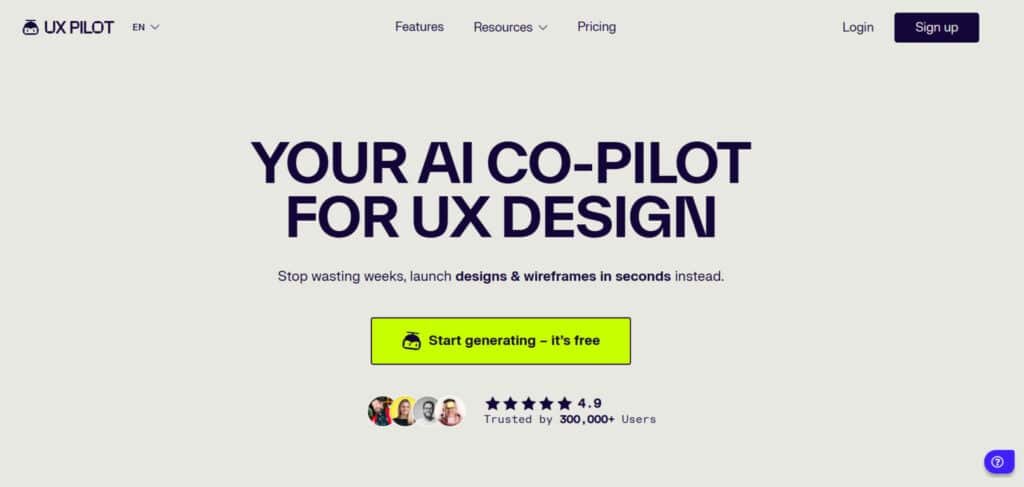
I’ve noticed a clear split in this new wave of design tools. Many, like v0.dev, focus heavily on generating code for developers. UXPilot takes a different path. It was built with a design-first approach, putting the needs of UX designers and product teams at the forefront.
This tool emerged to address the constant pressure to deliver exceptional user experiences quickly. Industry expert Adam Fard, Co-founder & Head of Design, endorses it as a comprehensive suite covering the entire design process.
| Tool | Primary Focus | Target User |
|---|---|---|
| UXPilot | End-to-end design process | Designers & Product Teams |
| v0.dev | Code Generation | Developers |
| Uizard | Rapid Prototyping | Designers & Entrepreneurs |
Purpose and Industry Endorsements
The purpose behind this product is straightforward. It aims to cut down repetitive tasks, freeing up time for critical thinking. It also creates a shared space for designers and developers to collaborate effectively.
This is a key reason why teams across various industries have adopted it. Startups use it to speed towards a minimum viable product. Established companies integrate it to refine their entire workflow. It’s a practical way to get more done.
What is UXPilot.AI?
The core concept behind this platform is remarkably simple: you write what you want, and it builds the interface. I’ve found it feels like having a design partner who understands exactly what you’re describing.
Inner Workings and Core Functionalities
This tool uses a specialized model trained specifically for UI and UX design. When you enter a text prompt like “create a login screen with social media options,” it generates a structured layout following established patterns.
The platform covers the entire design spectrum. You can toggle between wireframes for early concepts and high-fidelity screens for presentations. The infinite canvas lets you organize elements and leave sticky notes for team feedback.
| Feature | Traditional Method | UXPilot Approach |
|---|---|---|
| Wireframe Creation | Hours of manual work | Seconds with text prompts |
| Design Process | Linear and sequential | Iterative and collaborative |
| Code Export | Manual conversion needed | Clean HTML/CSS ready |
Benefits for Designers and Developers
For designers, the speed boost is incredible. What used to take hours now happens instantly. You can focus on user experience rather than repetitive pixel-pushing tasks.
Developers appreciate the clean code export. It provides a solid foundation for implementation without rebuilding layouts from scratch. The shared workspace creates better collaboration between teams.
The workflow feels natural—like co-creating with an intelligent assistant. This makes the entire app development process smoother and more efficient for everyone involved.
Complete Features of UXPilot.AI
What separates a good design tool from a great one often comes down to how well its features solve real workflow challenges. I’ve tested many platforms, and the standout capabilities here aren’t just impressive on paper—they actually address daily pain points for designers.
1. Core Design Generation Tools
These essential tools empower users to kickstart their designs with speed and confidence. Many users find this helpful when facing tight deadlines, as it turns ideas into visual designs quickly, reducing frustration from starting points.
Hifi Designer
The Hifi Designer generates high-fidelity UI designs instantly, creating pixel-perfect screens in just seconds from simple text prompts.
Users can describe what they need, and the tool produces structured layouts based on proven design patterns.
This gives users reliable starting points, eliminating the overwhelm of blank canvases. It also supports creating both wireframes and detailed high-fidelity elements from the same prompt, allowing users to move from rough ideas to polished designs seamlessly and explore options early in the process.
AI Wireframer
The AI Wireframer builds flexible wireframes tailored for desktop or mobile platforms. Users benefit by rapidly exploring a variety of UX concepts, generating detailed wireframes that match their specific requirements.
This helps users test and validate ideas without spending hours on manual drawing, making it easier to iterate and find the best direction before committing to full designs.
2. Process Enhancement Features
These features streamline every step of the design process, with strong support from the pilot figma plugin.
Users often appreciate how this integration saves time and keeps workflows smooth, especially when working across tools.
UX Conception (Integrated with Figma)
This feature allows generating UI screens on the web and transferring them effortlessly to Figma, or creating designs directly inside Figma using the pilot figma plugin. Users enjoy seamless exports to existing projects without any issues, which significantly reduces time during hand off and helps maintain momentum.
UI Design – Chat with Designs
Through an intuitive AI-powered chat interface, users can iterate on designs by requesting quick edits and refinements to high-fidelity screens.
This makes adjustments feel natural and fast, helping users achieve the desired look without complex manual changes.
UX Design – Screen Flows
Users can generate complete sequences of screens to map out user journeys, building multi-screen flows in a single session. This visualization helps users prototype entire experiences efficiently, ensuring cohesive designs from start to finish.
Research – UX Frameworks
The tool applies established UX methodologies, adapting them with AI to fit project needs. Users get structured guidance to tackle complex problems, providing a confident foundation for their designs.
Handoff – Source Code
It produces clean, ready-to-use HTML/CSS code as a solid base for development. Users find this bridges the gap to implementation smoothly, speeding up the overall hand off process.
UI Design – Mobile and Desktop
This supports creating designs with platform-specific patterns, ensuring interfaces feel intuitive and user-friendly on mobile or desktop. Users benefit from tailored results that consider device differences, leading to more effective and accessible designs that resonate with end users.
Ideation – Figma Diagrams
Using the pilot figma integration, it creates diagrams and sitemaps directly in FigJam. Users can visualize complex user flows and structures easily, which improves team planning and sparks better ideas during brainstorming.
Discovery – Interview Questions
It generates context-aware questions for user or stakeholder interviews. Users gain deeper insights into needs and preferences, helping prevent costly design mistakes down the line and build more empathetic designs.
3. Unique Advanced Features
These advanced features give users greater control and creativity, making it easier to produce varied, high-quality designs that stand out.
Control Visual Direction with Figma AI Design Generator
Users can define styles and align designs with brand guidelines right in Figma via pilot figma, ensuring consistent and precise outputs.
Intelligent Design Controls
With natural language prompts and fine-tuning options, users create full screens effortlessly, adjusting details to match their vision.
Unlimited Design Variations
Users experiment freely with different styles and structures, building adaptive designs that feel modern and versatile.
Swift Prototype Development
This enables quick creation of cross-platform prototypes, complete with ready code for faster testing.
Reference-Based Creation
Users import inspirations, and the tool replicates aesthetics intelligently, including color palettes, to match desired looks.
Wireframing
It supports rapid idea testing with aligned, detailed wireframes, helping users refine concepts early.
Figma AI Design Generator
Overall, it inspires fresh ideas and helps users sharpen their skills while enhancing designs.
These options help users innovate without limits, resulting in more unique and effective outcomes.
4. Predictive Analytics Features
This category provides valuable tools like data-driven insights to validate designs.
Predictive Heatmaps
Users can analyze layouts to see predicted attention areas, optimizing elements before real testing. Accessible via complimentary credits—even without a paid plan per month—this allows trying it risk-free. By accessing through side navigation, users upload designs and get clear feedback on hotspots, guiding improvements for better user engagement and satisfaction.
5. Collaboration and Review Features
These features support team input and feedback, helping users refine designs collectively.
Automated Design Reviews
The AI evaluates uploaded designs via the side Review button, offering improvement suggestions on usability, accessibility, and more. Users receive constructive feedback to polish their work effectively.
Team Collaboration Support
Through pilot figma plugin and FigJam diagrams, teams visualize and iterate together. This fosters shared understanding, allowing incorporation of diverse feedback for stronger designs.
These elements make working with others smoother, leading to collaborative success.
| Feature | Traditional Workflow | UXPilot Approach |
| Wireframe Creation | Manual dragging and placement | Instant generation from text |
| Design Export | Manual file conversion | Direct Figma plugin integration |
| User Testing Prep | Guesswork on user focus areas | Predictive heatmap analysis |
Pricing Plans of UXPilot.AI
Let’s talk numbers – understanding the cost structure is crucial when evaluating any new platform for your workflow. I appreciate when companies keep their pricing straightforward, and this tool does exactly that with screen-based plans instead of confusing token systems.
Plan Comparisons and Feature Limits
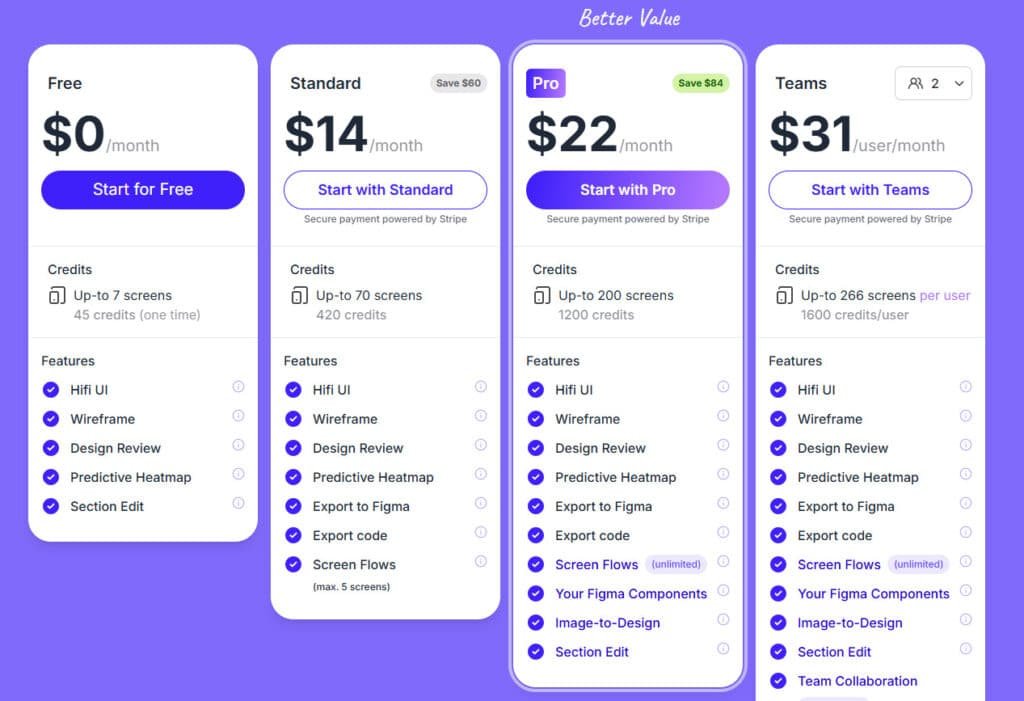
Free
$0/month (one-time credits, same for annual). Up to 7 screens with 45 credits. Features: Hifi UI, Wireframe, Design Review, Predictive Heatmap, Section Edit.
Standard
$19/month or $14/month (annual, save 25%). Up to 70 screens with 420 credits. Features: Hifi UI, Wireframe, Design Review, Predictive Heatmap, Export to Figma, Export code, Screen Flows (max. 5 screens).
Pro
$29/month or $22/month (annual, save 25%). Up to 200 screens with 1200 credits. Features: Hifi UI, Wireframe, Design Review, Predictive Heatmap, Export to Figma, Export code, Screen Flows (unlimited), Your Figma Components, Image-to-Design, Section Edit.
Teams
$39/user/month or $31/user/month (annual, save 25%). Up to 266 screens per user with 1600 credits/user. Features: All Pro features plus Team Collaboration (coming soon), Shared Pool of Credits, Import Your Own Components, Custom Integration, Custom Onboarding, Seats and Roles, Priority Support.
Enterprise
Custom pricing. Features: All Pro features, Unlimited access, Import Own Design System, Custom Integration, Role-based Access Control, Personalized Onboarding, Priority Support.
| Plan | Monthly Price | Annual Price (per user) | Credits/Month | Key Highlights |
| Free | $0 | $0 | 45 (one-time) | Basic generation & analysis |
| Standard | $19 | $14 | 420 | Figma/code export, limited flows |
| Pro | $29 | $22 | 1200 | Unlimited flows, custom components |
| Teams | $39/user | $31/user | 1600/user | Collaboration, shared credits |
| Enterprise | Custom | Custom | Unlimited | Full customization & support |
Cost Breakdown and Value Proposition
Each pricing tier scales logically with your project requirements. For individual designers, the entry-level options provide excellent value. Larger teams will find the higher tiers cost-effective for collaborative work.
The real value comes from how these plans accelerate your design generation process. When you calculate the time saved on initial designs, the monthly investment often pays for itself quickly.
Pros & Cons of UXPilot.AI
No tool is perfect, and my hands-on testing revealed both brilliant innovations and frustrating limitations. After extensive evaluation, I’ve identified clear strengths and weaknesses that could make or break your decision.
Advantages and Strengths
The platform truly excels at accelerating the initial design phase. I found the wireframe generation particularly impressive—it creates layouts that follow solid UX principles without manual tweaking.
For teams, the Figma plugin integration is a game-changer. The two-way sync and editable exports save significant time during handoff. The predictive heatmaps provide valuable user feedback before actual testing.
- Generates wireframes and UI layouts following established UX patterns
- Deep Figma integration with seamless plugin functionality
- Predictive analytics for early design validation
- Clean code export that developers can use immediately
Drawbacks and Areas for Improvement
While the core features work well, I noticed some limitations in complex interface scenarios. The AI sometimes struggles with highly customized designs that break from standard patterns.
The learning curve exists despite the beginner-friendly claims. New designers might need time to master the prompt-based workflow. Some advanced tools like Uizard offer more prototyping flexibility.
- Limited customization for non-standard design requirements
- Prompt-based workflow has a learning period
- Less prototyping flexibility compared to some alternatives
These considerations lead naturally to exploring other options in the market.
Alternatives to UXPilot.AI
When choosing design software, it’s smart to look at the whole playing field. If this particular tool doesn’t align with your workflow, several strong competitors offer different approaches. I’ve tested most of them personally.
Let me give you an honest comparison of how they stack up for various project needs.
Competitor Analysis: Banani, Uizard, Relume, and More
Banani stands out with a similar feature set. It generates wireframes and high-fidelity UI flows from prompts or images. Its multi-screen design capability is particularly strong.
A major advantage is its free trial. It allows unlimited design generation and edits without forcing immediate payment. This is great for thorough testing.
Uizard excels in rapid prototyping. It’s fantastic for quickly mocking up app layouts and getting feedback. Relume is a powerhouse for website design, focusing heavily on structure and code generation for developers.
| Tool | Core Strength | Ideal For | Trial Model |
|---|---|---|---|
| Banani | Multi-screen flow generation | Designers building complex user journeys | Unlimited free generations |
| Uizard | Rapid prototyping speed | Teams needing fast concept validation | Freemium plan |
| Relume | Website structure & code | Developers and web-focused designers | Free library access |
Unique Selling Points of UXPilot.AI
So, what makes this platform stand out in a crowded market? Its design-first philosophy is the key differentiator. While others might prioritize code, it focuses on the entire design process.
The predictive heatmaps for user attention are a unique advantage. This feature provides valuable pre-testing feedback on your layouts. It helps optimize elements before you even show users a prototype.
For teams, the deep Figma integration creates a seamless workflow. It bridges the gap between designers and developers effectively. This end-to-end approach covers the product creation flow comprehensively.
Case Study and Personal Experience
I decided to take this tool beyond simple demos and integrate it into my actual workflow with paying clients. The results surprised me—both in terms of time savings and the quality of output.
Real-World Implementation and Results
Testing with a fintech app onboarding flow proved particularly revealing. The platform generated clean, professional layouts that followed established UX principles. Complex prompts involving multi-screen flows worked remarkably well.
The predictive heatmaps immediately flagged when CTAs got lost in visual clutter. This provided valuable user feedback before actual testing. The Figma plugin integration saved significant time during handoff.
| Project Type | Traditional Time | With This Tool | Time Saved |
|---|---|---|---|
| Fintech Onboarding | 8-10 hours | 2-3 hours | 70% reduction |
| E-commerce Flow | 6-8 hours | 1.5-2 hours | 75% reduction |
| Landing Page Design | 4-5 hours | 1 hour | 80% reduction |
My Personal Journey with UXPilot.AI
The first week involved a learning curve with the prompt-based workflow. By week two, I was generating complete user flows in minutes instead of hours. The speed boost allowed me to focus on strategic design decisions rather than repetitive tasks.
Collaborating with developers became smoother thanks to clean code exports. The entire design process felt more integrated and efficient. This tool truly changed how I approach client projects.
Conclusion
The testing phase is complete, and now comes the moment of truth: does this investment make sense for your workflow? After putting UXPilot through rigorous real-world testing, I can confidently say it delivers on its core promise.
This tool excels at accelerating the initial design process with impressive time savings. The predictive heatmaps and clean code export make it valuable for teams needing quick validation.
Should You Buy It? If you’re a UX designer or product team building digital interfaces, absolutely. The pricing is reasonable, and the speed boost pays for itself quickly.
Start with the free plan to test the features. If you need to move from concept to validated designs faster, this AI-powered solution could transform your workflow.
Frequently Asked Questions
What is the primary function of the UXPilot Figma plugin?
The main job of the plugin is to generate UI layouts and wireframes directly inside Figma. You give it a text prompt describing what you want, and it creates the visual elements for you, speeding up the initial design phase significantly.
How accurate is the AI-generated output for complex app screens?
For standard layouts like login screens or dashboards, the output is quite good. However, for highly complex or unique user flows, you’ll likely need to do some manual tweaking. It’s a fantastic starting point that handles the heavy lifting.
Can developers use the code export feature for production?
The exported code is clean and well-structured, making it a great foundation. Developers can absolutely use it to jumpstart development, but it will still require integration and refinement to fit a specific project’s architecture and standards.
How does the predictive heatmap feature work?
This clever feature uses AI to analyze your design and predict where users will likely focus their attention. It simulates user behavior before you even build a prototype, helping you optimize the placement of key elements for better usability.
Is there a free plan available to test the tools?
Yes, there is a free tier that gives you a limited number of generations per month. It’s perfect for trying out the core functionalities, like AI-UI generation and the Figma plugin, to see if it fits into your workflow before committing to a paid plan.
How does this tool compare to competitors like Uizard or Relume?
UXPilot’s deep integration with Figma is a major differentiator. While other tools are great, UXPilot feels like a natural extension of the design environment many professionals already use daily, which streamlines the workflow rather than creating a separate one.
What is the biggest advantage for design teams?
The biggest win is the sheer speed. It dramatically cuts down the time spent on creating initial wireframes and layouts. This allows teams to iterate faster, test more ideas, and focus their energy on refining the user experience rather than building it from scratch every time.